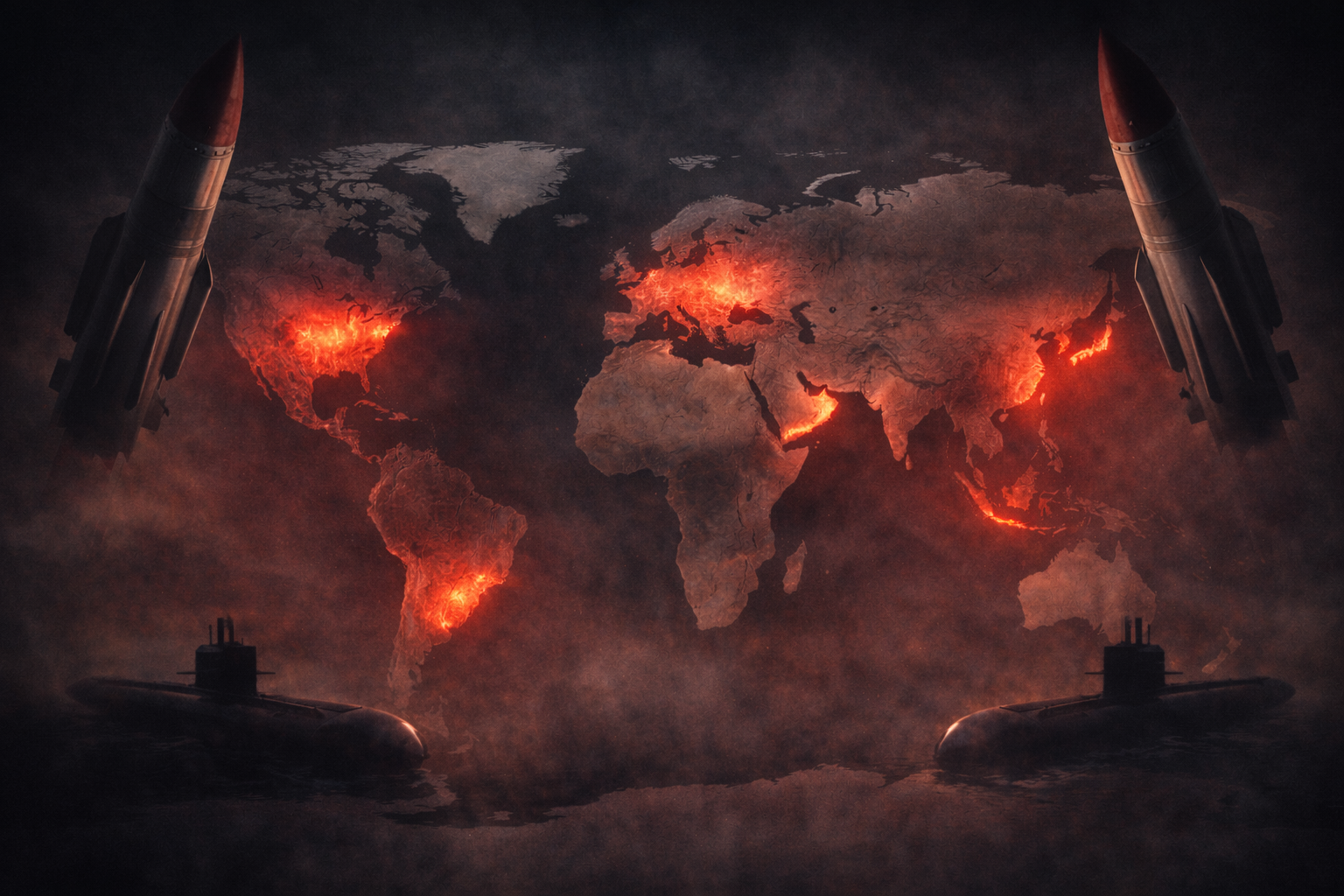
When people talk about World War III, they often imagine an apocalyptic conflict where the world’s most powerful nations are fighting each other directly a war involving massive armies, global battlefronts, and potentially the use of nuclear weapons. This dramatic vision usually dominates public discussions. However, the modern definition of global conflict is broader and more complex.
Today, a world war would not necessarily begin with large armies marching across borders. Instead, it could emerge gradually through proxy wars, economic sanctions, cyber attacks, sabotage operations, and information warfare. Elements of this kind of global confrontation are already unfolding in different parts of the world.
A World of Rising Rivalries
One of the most significant conflicts shaping global geopolitics today is the war between Russia and Ukraine, which began with Russia’s full-scale invasion in 2022. While Ukraine and Russia are the direct participants, the war has drawn in wider international involvement. Western nations, particularly the United States and European allies, have supported Ukraine with weapons, funding, and intelligence. Russia, meanwhile, has strengthened ties with countries such as Iran and North Korea. The war has effectively become a geopolitical contest between Russia and the Western alliance.
Another flashpoint lies in the Middle East, where tensions between Israel and Iran continue to intensify. Although the two countries rarely engage in direct warfare, they are frequently involved in indirect confrontation through proxy groups, cyber operations, and targeted strikes. Escalation in this region could easily draw in regional and global powers, given the strategic importance of Middle Eastern energy supplies and political alliances.
The Taiwan Question
Perhaps the most widely discussed potential trigger for a major global conflict is Taiwan. The island operates as a self-governing democracy, but China considers Taiwan part of its territory and has repeatedly stated that reunification with the mainland is inevitable. Despite this, no direct military confrontation has occurred, making the situation resemble a Cold War–style standoff rather than an active war.
Taiwan’s importance extends far beyond politics. The island plays a crucial role in the global economy through the “silicon shield.” Taiwan produces a large portion of the world’s most advanced semiconductor chips, which are essential for technologies ranging from smartphones to artificial intelligence systems and military equipment. Companies like Taiwan Semiconductor Manufacturing Company (TSMC) dominate this industry. Because of this, whoever controls Taiwan could influence a significant portion of the global technology supply chain.
The stakes were highlighted when U.S. President Joe Biden, during an interview, was asked whether the United States would defend Taiwan militarily if China attacked. Biden responded “yes,” signaling a willingness to intervene. This statement appeared to depart from the long-standing U.S. policy of “strategic ambiguity,” where Washington intentionally avoids clearly stating whether it would defend Taiwan in order to deter both Chinese aggression and Taiwanese declarations of independence.
Emerging Military Alliances
As global tensions increase, nations are strengthening alliances that could shape the balance of power in a future conflict. One example is AUKUS, a security partnership between Australia, the United Kingdom, and the United States. The alliance focuses on advanced military cooperation, including the development of nuclear-powered submarines for Australia.
Other alliances are also becoming more prominent. NATO, the long-standing military alliance of Western nations, has expanded its support for Ukraine and increased military preparedness in Europe. Meanwhile, China and Russia have deepened strategic cooperation, conducting joint military exercises and coordinating positions on global issues.
The Nuclear Factor
Any discussion of a potential world war inevitably leads to the subject of nuclear weapons. Today, several countries possess nuclear arsenals, including the United States, the United Kingdom, France, China, Russia, Israel, North Korea, and others believed to have nuclear capabilities. These weapons fundamentally shape international politics because they create a powerful deterrent: once a country possesses nuclear weapons, attacking it becomes far riskier for adversaries.
This is partly why countries such as Iran have pursued nuclear technology programs in the past. States seek nuclear capability because it can make them effectively untouchable by conventional military force, as major powers hesitate to provoke nuclear retaliation.
How a World War Could Begin
For a third world war to occur, there must first be a major rivalry between powerful states. Today, several such rivalries exist simultaneously: the United States and China competing for global influence, Russia and the West confronting each other over European security, and regional rivalries such as Iran and Israel.
Yet large wars rarely start deliberately. Historically, they are often triggered by a spark a single incident that escalates unexpectedly. One side might take an action believing it will provoke only a limited response, such as a military strike, blockade, or cyber attack. Instead, the opposing side could interpret it as a major threat and respond with overwhelming force. In a world of alliances and nuclear weapons, that escalation could rapidly spread across regions.
A Fragile Global Balance
Despite these risks, global leaders are also aware of the devastating consequences of a world war. The existence of nuclear weapons has, paradoxically, acted as a powerful deterrent, encouraging countries to avoid direct confrontation. Instead, competition often unfolds through indirect means diplomacy, economic pressure, technological rivalry, and regional conflicts.