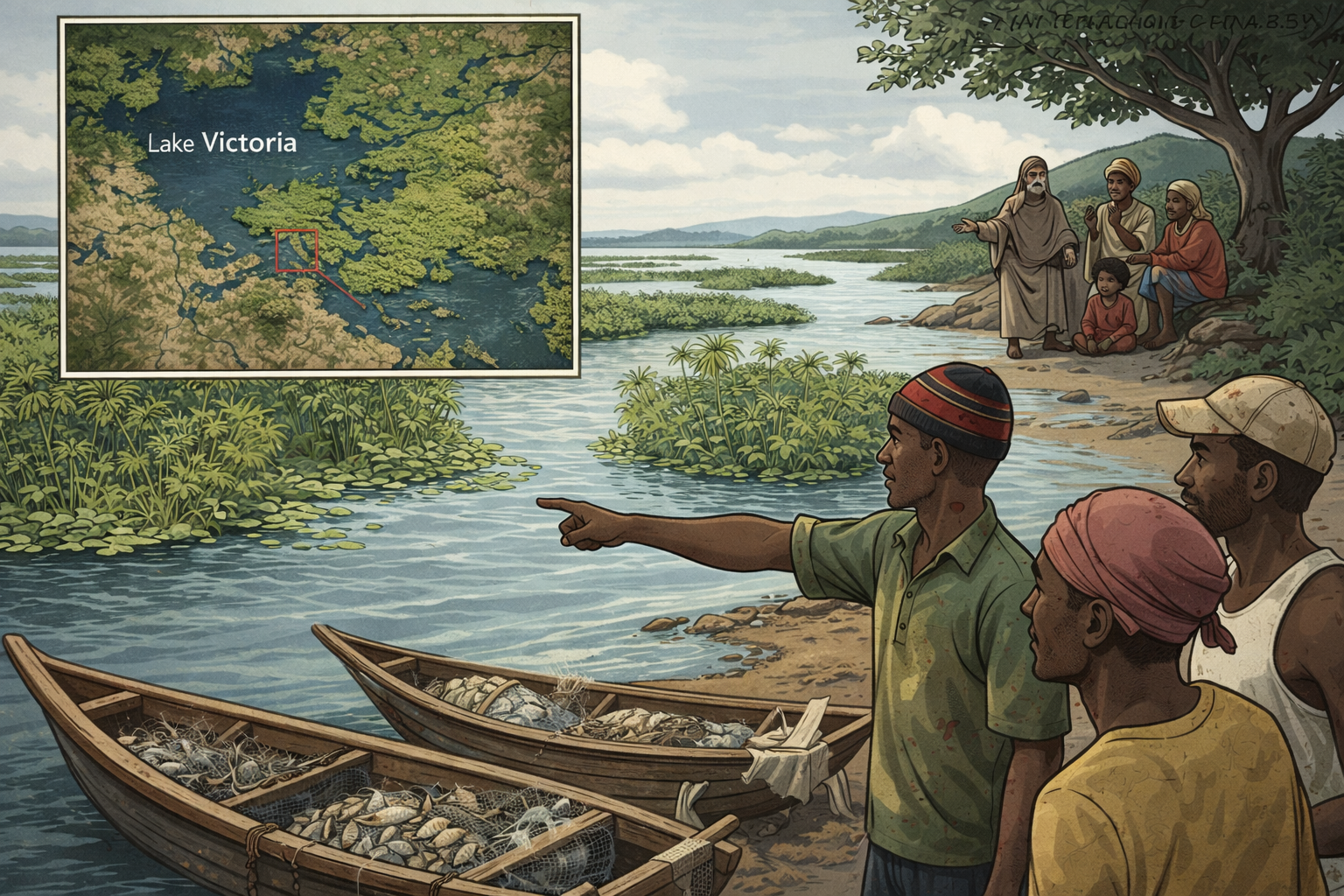
Lake Victoria has always existed between two narratives the measured language of science and the colorful voice of folklore. From Kisumu to Bukoba, travelers tell of islands that drift away by morning, of boats that lose direction in sudden fog, and of strange movements on the water that defy common sense. These accounts did not arise from imagination alone; they were born from real encounters with a vast and unpredictable lake.
For centuries, communities interpreted these events using the tools available to them, storytelling and tradition. Today, researchers using satellites, climate records, and ecological surveys are uncovering explanations that shed light on what people have witnessed for generations. The mysteries are not being dismissed; they are being understood.
Myths vs. Research-Based Explanations
| Mystery / Claim | How People Describe It | Scientific Explanation & Named Research |
|---|---|---|
| Islands that vanish overnight | Fishermen say an island seen in the evening cannot be found the next day; some believe the lake “swallows” land. | A GIS study from Makerere University (2022) on floating islands of Lake Victoria documented that large mats of papyrus and water hyacinth detach from shorelines and drift with wind currents, creating the illusion of moving or disappearing islands. |
| Floating islands with trees and birds | Witnesses insist some “islands” support vegetation and even small animals like real land. | Ecological surveys described in the African Journal of Ecology show that compacted root systems can support shrubs and bird colonies while still remaining mobile rafts rather than solid ground. |
| Sudden changes in lake size without rain | Communities say the lake rises or shrinks mysteriously, independent of local weather. | Analysis by NASA Earth Observatory (satellite altimetry reports 2000–2023) confirms that Lake Victoria water levels fluctuate due to regional rainfall in the Nile Basin and evaporation rates, sometimes by several meters over a few years. |
| Boats getting lost on familiar routes | Sailors report confusion during dawn and dusk even when they know the shoreline well. | Studies in the Journal of Applied Meteorology explain that temperature inversions over large lakes create dense fog and optical refraction that distort distance and direction. |
| Compasses and phones misbehaving | Some believe certain zones interfere with navigation devices. | The Journal of Navigation (2019) notes that electronic compasses can be affected by mineral deposits around the lake basin and by poor calibration in high-humidity environments. |
What the Studies Reveal
Modern research paints a consistent picture:
-
Floating vegetation is the main actor.
The Makerere University mapping project identified hotspots where hyacinth and papyrus regularly break away. Wind models showed these rafts can travel kilometers within days, perfectly matching eyewitness reports. -
Water levels are naturally dynamic.
NASA’s long-term satellite measurements demonstrate that Lake Victoria responds to regional climate cycles rather than only local rainfall. Shorelines that appear permanent in one decade may be submerged in the next. -
Human perception is easily fooled on open water.
Meteorological research confirms that fog, mirages, and echoing sound over large lakes distort the senses, explaining why even experts sometimes misjudge distance.
Why the Legends Endure
Science explains the mechanisms, but it does not erase experience. A fisherman who nearly crashed into a drifting papyrus raft at night will remember it as an island that “moved.” A traveler lost in thick morning mist will speak of the lake hiding its paths. These stories became the cultural memory of the region.
Rather than opposing tradition, research now translates it turning oral observations into environmental knowledge.
The Real Wonder of Lake Victoria
The truth behind the mysteries is arguably more fascinating than myth. Few lakes on Earth combine such vast size with delicate wetlands, invasive plants, and sensitive climate balance. The “vanishing islands” are evidence of a living ecosystem in constant motion.
As technology improves, communities around the lake are beginning to document these changes themselves, blending ancestral wisdom with satellite maps and weather data. The mysteries of Lake Victoria are not disappearing, they are being answered.